The Hollywood Reporter asked Colin Trevorrow about women directing blockbusters and he repeated the meme that's surfaced claiming that women directors are self-selecting themselves out of the running. Behind the comment is the ages-old idea that women are too something-so-good that they actually need the protection of men, or wouldn't want to sully themselves, or are not shallow enough, or maybe just don't have a penis and so naturally don't belong where the money, power, and scope also just happen to be.
Since I run a women's film festival, I know plenty of women who say they'd like to direct a blockbuster, but because they're not delusional, they focus on stories they are likely to be funded to make. Or that they can make with self- and crowd-funding.
Treverrow's comment is the same argument as colleges that say they want diverse faculty but the candidates aren't there. Yes, self selection is a factor, only because of structural inequality making the price too high for one group that isn't ever asked of another. And before you tell me, a pretty good cook, about the heat in the kitchen, let me explain with a different metaphor.
Let's say we're all playing a video game, but the controller we use is unique to each person. Now imagine that the game settings are different for different types of people. If you're a white male, yours is on the easiest setting and if you are female, the game settings are higher. The guys compete and prove themselves against one another and develop skill and expertise they feel proud of. But only so long as they believe the game is fair. They cannot accept and still feel good that a woman has to play at a much higher setting where a single hit takes her health to zero and sends her back to square one. They can take out a monster with one or two hits where she needs half a dozen, by which time she's dropped points and armor and so needs to spend time and coin to get back to full strength. He blames her weakness because seeing how the scoring is rigged would rob him of his hard-won status.
As for the women, some battle it out, determined to be twice as good and to beat the guys despite their hidden advantage. Other women leave the game, deciding to compete in an arena where their abilities are rightly valued. Neither is the better choice, neither is right, neither is wrong. Nor is choosing to attack and sabotage the game. We're here, our dreams are legitimate, and we can only play a game we believe there is a chance of succeeding at.
I do think women have to restrain themselves from internalizing the external inequity. I think we have to remember that the game is rigged and withhold respect from those who score and dominate while playing at the kiddie settings while the rest of us struggle to play at all at settings that are so high it is hard to get out of the starting realm.
I just read this list: http://www.thetoptens.com/comedy-movies/. It's supposedly the top 10 comedies of all time. Me, I thought it was dimwitted. Stupidity-and-behaving-badly films mostly. Then I realized it could be a list of the top ten boy movies of all time. I have no opinion about that. But though I do like the occasional S&BB film like Groundhog Day, comedy is more than the vicarious pleasure of watching (and possibly identifying with) oblivious dicks.
How about it Broads? Am I wrong, or do you agree with me that a top ten list for comedies would be entirely different if women's opinions counted?
It seems that making narrative films was the brain-child of a woman,
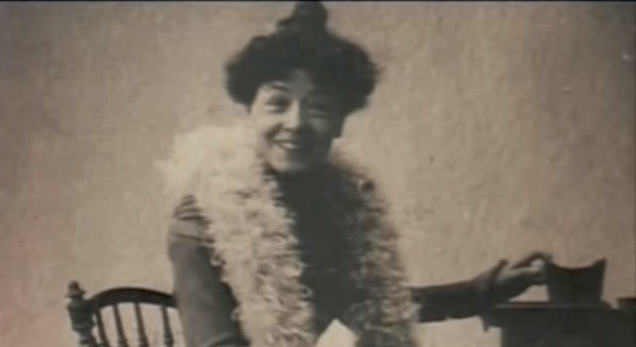
Alice Guy, who not only was the first female filmamaker ever, but whose
24-year career saw her writing, directing, and producing over 1,000
films from 1896 to 1920. She was the origin of many innovations in
filmmaking, including using double exposure, running film backward,
synching music to films, and location shooting, to name a few. Guy-Blaché
not only was one of the first to put narrative fiction on film, she
shaped the director's role in the process into what we think of it to be
today. She hired and trained a generation of filmmakers. Anthony Slide recounts in his history of female silent filmmakers, "it was as if, with one mighty stroke, she had single-handedly created
the entire French film industry," Hers is not only the longest career of any film pioneer, man or woman,
but she still is the only woman to manage and own a studio.
So how come you never hear of this woman whom Barbra
Streisand described as "a French film
pioneer who invented the director's job?" Good question.
It
is unclear why, when Gaumont published a history of the film industry
in France, her name was entirely absent. When she called Gaumont on it,
he promised to correct the oversight in subsequent editions. That never
happened. Apparently,
she has been "re-discovered" many times in recent years, but her name
and accomplishments still go unacknowledged by official film history. Any one of her directing accomplishments should have secured her a place in the pantheon. For example:
... as one of the first persons to direct a film with a narrative structure,
and thus to direct actors to convey the essence of the narrative
through gestures and actions, Alice Guy is one of the originators of
filmic acting, both in theory and in practice. Indeed, she is the first
real auteur of the cinema. (from Film International )
If
you've studied film you probably have seen Sergei Eisenstein's Potëmkin
and the "innovative" use of close-ups and reaction shots, shots that Guy
used in 1904 film "The First Cigarette." You can read a great article
about Alice Guy at Film International or just scan the basic facts below. I've also posted a YouTube video of one of her early comic films, The Consequences of Feminism (1906), which is a reverse-sexism film not unlike many we get submitted to the festival.
For
me, her story, what she did vs. how she is remembered, is a good lesson
in structural barriers to women's success. It is not enough to level
the playing field. If the score keepers fail to mark the wins by women,
it will create an atmosphere of disregard. Yes, a woman may seem
skilled or competent, but commonplace thinking asserts that if women
were really as capable as men, there would be more of their work through
history. Novels. Paintings. Films. Structural inequities erase
notice, and don't result in a conscious conspiracy, but rather a
self-perpetuating neglect. Just as in child-rearing, indifference and
neglect are far more damaging to the psyche than domineering and abuse,
so too for women's creative work this indifference destroys our inner
"muse" with a suffocating vacuum. All the while preserving a
comfortable deniability of chauvinism.
So what about
Guy-Blanché? She worked for the French inventor Léon Gaumont when the
company was primarily a maker of photographic equipment. After
accompanying her boss to a screening of a 35mm demo by the Lumiere
brothers in 1896, she asked for permission to use the company cameras to
make her own film. She got approval contingent on the filming not
interfering with her secretarial duties. She made La fée aux choux,
one of the world’s first films with a plot shot in her own garden with
the help of a female friend. Her films were very successful.
La Fée aux Choux by Alice Guy-Blanché 1896
She become the head of production of the
Gaumont film studio from 1897 to 1907. But she got married to co-worker
Herbert Blanché who was almost 10 years her junior, and, well, as a married woman was expected to retire.
Raise children.
So she and her husband left for the
US, where they formed Solax, one of the largest pre-Hollywood studios in
America. She was the artistic director while her husband was the
production manager. Even while she was pregnant with her second son, she
completed at least a film a week, proving that the Hollywood horror,
voiced at a Women in Film breakfast I remember, that a woman might get
pregnant and ruin a film's production schedule and be rendered by her
condition unable to command the shooting of a picture, is suspect
baloney worthy of Upton Sinclair's novel, The Jungle.
Hollywood's
climate was more congenial to filmmaking, and when husband Herbert
headed west with a starlet on his arm in 1918, Alice remained until 1922
when the divorce was final. She then sold the studio and went back to
France.
Perhaps Alice Guy-Blanché is the reason that the French have more successful, working women directors than any other country.
I was just watching Gnarly in Pink and enjoyed watching the little 6-year-old girls skateboarding in their tu-tus. They were definitely little girls but also definitely athletes. Then they put up the statistic:
By the age of 14, girls are twice as likely to drop out of sports as boys.
My immediate thought was that by the age of 14, girls' bodies have gone through a huge metamorphosis that boys do not have to deal with for a few years. Things like your center of gravity moving lower. Widening hips putting strain on the knees. Depth perception according to female tennis players who lament about how water retention before their period altering their ability to track the ball. I don't say that this proves that girls can't do sports after puberty, only that we need to recognize it and openly look capitalize on the strengths of women's bodies rather than pushing activities that only can be done by androgynous or amenorrhea-induced bodies. I speak from experience, not as an athletic girl who lost her prowess to puberty, but one who found the pleasure in physical activity once her body changed. I had always been the last on chosen for team sports. I had little upper body strength and short legs that made running races a loser's game for me. My dad taught me tennis at 9 and I tried my best, but was weak, lacking the long limbs and robust body type of the more tomboy-ish girls. That's why I will never forget the day in seventh grade when I suddenly could do something effortlessly in gym class that all the other physically fit girls struggled with. We were learning how to jump on a trampoline. Once we all got the basics, the teacher demonstrated something called "swivel hips." You were supposed to bounce sitting, twisted in the air, and come down sitting facing the opposite direction. It was good-natured fun watching the girls try to find the coordination for that mid-air twist. When my turn came, I sat, swung my broadening 13-year-old hips in a circle, and landed effortlessly facing the opposite direction. Admiration and praise for doing something in GYM! Never happened before. A world opened up to me. I had always been placed in the last row in ballet class. But at 14 I took jazz, and suddenly I was in the front row. My twisty, sinuous, hippy body put me in the middle of my own, private, ugly duckling story. I even got better at tennis, learning to use my spine to snap a whipping backhand. I have ever since been a physically active person, a person who has spent a lifetime practicing dance and mime, was a clown in the circus, and who has taught movement, yoga, and dance to others. All this was the gift of my changing body. The above statistic doesn't mention how many girls take up dance. How many start yoga. (Nor how many of the boys who quit sports, too, end up practicing these healthy, physical activities.) Maybe girls do leave "sports" but then many "sports" are designed with the architecture of the male body in mind. Once I realized I had a perfectly capable female body, I stopped wishing to be accepted for being able to do things privileged by the form and strengths of the male. I offer no criticism of women whose body type lets them continue with the sports they enjoyed as girls, only that there should be activities that reveal what was revealed to me in a jazz dance class in France once.
It was a dance class associated with the university during my junior year abroad. I was paying for three classes a week at this studio and taking the dance class that came with my enrollment for a fourth. Three young men from Iran had come to study at the university and decided to take the class for their physical education credit. They entered the class confidently, seeing the little, lithe female instructor and short-legged, hippy me. She started what for me and for her was a slow, basic warm-up and set of moves. The muscled trio struggled with all the core work, the fluid stretching, and the loose dynamics of the moves. After 45 minutes they were incapacitated, and the instructor ended the class early. I had barely gotten warmed up, but understood. This class for them was what gym class had been for me in 6th grade; all rope climbing and pushups. The three students never came back, and I wonder some times if the number of guys who say they don't dance is a reflection of their inability to take what was dished out to me almost daily until puberty. I propose that moving with grace, that flexibility and core strength should be as privileged in elementary schools so that boys learn to respect "girlie" abilities such as "princess" poise and "ballerina" flexibility.
Great site where you can make a chart resume for free. If you send a link rather than a graphic file, the resume will be interactive with more details in the rollovers. Great for us artist types who do many jobs at the same time. Here's what I was able to do pretty quickly by copying and pasting from my resume. Click on it and you can see the resume on the site, plus you'll get the fun background image instead of the plain white you see here...
From Indiewire: Jane Campion and her female Cannes jury members
Great article on Indiewire about gender bias, with data and info for women filmmakers.
I know, I know. I'm just as tired as you are of complaints that women don't get a fair shake in the film biz. We have to get over that fatigue, in my opinion, just like marathon runners have to get over being tired halfway through a race. The inequity is real. It's entrenched. Changes are happening at a glacial pace, if at all. But I like to think that maybe Stephen Jay Gould's concept of "punctuated equilibrium" for evolution applies to social change as well. The system, unfair though it may be, is trying to maintain its identity in equilibrium. So it will resist change that threatens to radically alter its identity. A few random "mutations" may survive or breed out in a generation without shifting the species, like the few lucky women who catch a break.
(NOTE: I don't call them "lucky' because they succeeded entirely on luck. I know they are all incredibly talented and hard-working. Their luck is in having their hard work get suddenly rewarded, while other equally hard-working and talented women get bupkiss.)
When external pressure creates situation where the old attributes no longer fit the environment, survival suddenly encourages mutations that fill the niches of opportunity. At these times, species evolve very quickly and dramatically until they settle into a new equilibrium that fits the new environment.
Look at how gay marriage initiatives, stalled and thwarted for so many years, suddenly reached critical mass and state after state has been passing marriage equality legislation. If we keep the pressure up with our "complaining" and keep making films on whatever platform we can, these may turn out to be good times to be a female filmmaker. After all, we're already in the middle of a flux period in the entertainment business. Technology is putting on some pressure. Changing social norms are putting on more pressure.
(Hat tip for the Indiewire article to Judy Chaikin and the Alliance for Women Directors.)